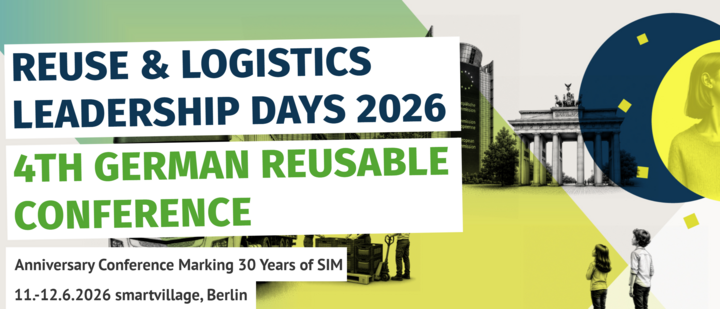
Freshlybottled: Dr. Oldenburg, the Reuse & Logistics Leadership Days 2026 are taking place at a pivotal moment for the industry—what key message would you like to share with participants in advance?
Dr. Jens Oldenburg: I see several clear messages. The most important one is that reusable packaging is the right answer to issues such as supply chain resilience in difficult political times, logistical challenges, and climate protection. Reusable packaging offers both economic and environmental benefits. Furthermore, during the two-day event, we will demonstrate just how innovative reusable packaging can be and that it has long been the backbone of German and European supply chains. With what is likely Germany’s largest reusable packaging event, we will also showcase the sheer size and strength of the entire reusable packaging industry.
Freshlybottled: The European Packaging and Packaging Waste Regulation (PPWR) establishes a new regulatory framework—what specific impacts do you anticipate for companies along the supply chain?
Dr. Oldenburg: I see significant opportunities for companies that actively embrace these changes. However, this is likely true of many transformations. The PPWR offers the opportunity to finally set European standards. Twenty-seven different packaging laws hinder the development of the European single market. The PPWR certainly still has some substantive flaws in its current form. This includes, for example, the protection of existing reusable systems and the exemption of cardboard from the regulations. But failing to move forward with implementation now because of these flaws is absolutely the wrong response.
Freshlybottled: What Opportunities Might This Present?
Dr. Oldenburg: A unified European single market offers the opportunity to strengthen Europe amid the challenging political conditions I mentioned earlier. This is particularly important because supply chains have long since ceased to be purely national in scope. Companies that take advantage of these opportunities now stand a good chance of gaining market share.
Freshlybottled: The program includes keynotes, panels, expert forums, and masterclasses—which formats are particularly important to you personally?
Dr. Oldenburg: The exchange among stakeholders is the most important goal. The keynotes provide a clear impetus in terms of content. Among the highlights are certainly the fact that Federal Environment Minister Carsten Schneider, Tübingen Mayor Boris Palmer, marine biologist Dr. Frauke Bagusche, and Dr. Eckardt von Hirschhausen will be guests. In addition, the expert forums offer a unique opportunity to exchange and learn about a wide variety of perspectives, thereby also engaging the audience in these different viewpoints. I see the masterclasses as a tremendous opportunity to discuss topics such as AI, research findings, and supply chain issues in a smaller, more focused setting. In short: All three formats offer the opportunity to make these two days truly engaging!
Freshlybottled: What key topics can participants look forward to in particular?
Dr. Oldenburg: I would highlight the exchange with political leaders and, above all, the discussions among sales representatives. Questions from the PPWR regarding the future of supply chains will be the central focus.
Freshlybottled: The list of speakers is top-notch—who will be attending, and what did you focus on most when selecting them?
Dr. Oldenburg: The event is also called Leadership Days. This reflects our goal in designing the program. For all panels, we have decision-makers, leaders, and people who want to make a difference on stage. Personally, I’m currently having a hard time deciding which of the three stages I want to listen to, since all the program items are going to be very exciting.
Freshlybottled: Around 40 exhibitors and startups are presenting solutions across the supply chain—what innovations are you particularly looking forward to seeing here?
Dr. Oldenburg: Here, too, the goal is to showcase the wide variety of reusable solutions. Among other things, there are solutions in the areas of B2B, B2C, horticulture, beverages, food, manufacturers, pool operators, label producers, innovative technology companies, and much more. The joint booth of “GFGH” and “ProMehrweg” will also be a central hub. Our goal is to demonstrate that the reusable packaging sector is incredibly innovative. I am convinced that I would spend a long time at every exhibitor’s booth, filled with great enthusiasm.
Freshlybottled: Are there any specific speakers or program highlights that you would personally like to emphasize?
Dr. Oldenburg: With nearly 100 speakers, it’s difficult to single out any one in particular. Carsten Schneider, Boris Palmer, Jürgen Trittin, Eckardt von Hirschhausen, Martin Schoeller, and Emanuelle Maire from the European Commission will likely attract the most attention. But speakers such as Prof. Dr. Bernhard Lorentz, Global Head of Sustainability at Deloitte, Gunda Rachut, Executive Board Member of the Central Agency, and Prof. Dr. Henke from Fraunhofer IML will also provide us with extremely fascinating perspectives. From a purely German perspective, it’s the decision-makers from organizations such as GFGH, IFCO, EuroPoolSystem, Pro Mehrweg, and even the DUH.
Freshlybottled: With the Reusable Innovation Award and the foundation’s 30th anniversary, there are some special highlights—what do these events mean to you personally and to the industry?
Dr. Oldenburg: Thirty years of the Reusable Foundation is certainly a history we could look back on with pride. But for us, it’s much more important to look to the future! This also applies to the Reusable Innovation Award. We could look back at the award’s history every year, but we want to consciously focus on exciting innovations and the future. The future belongs to reusable packaging, and this will be a recurring theme throughout the event.
Freshlybottled: Dr. Oldenburg, thank you for this conversation.