The ATC is designed to bridge the gap between laboratory innovation and industrial-scale production. Pilot-scale bioreactors for precision fermentation and cell cultivation simulate industrial conditions, allowing companies to validate and optimize their processes early. Thermal processing and aseptic filling ensure food safety and stability, while membrane filtration, spray drying and centrifugation support downstream separation and formulation, which are critical steps for product quality, texture and cost-efficiency. Advanced labs enable microbiological, cell-based and analytical testing under one roof. The facility is powered entirely by renewable energy, and a solar park generates surplus electricity.
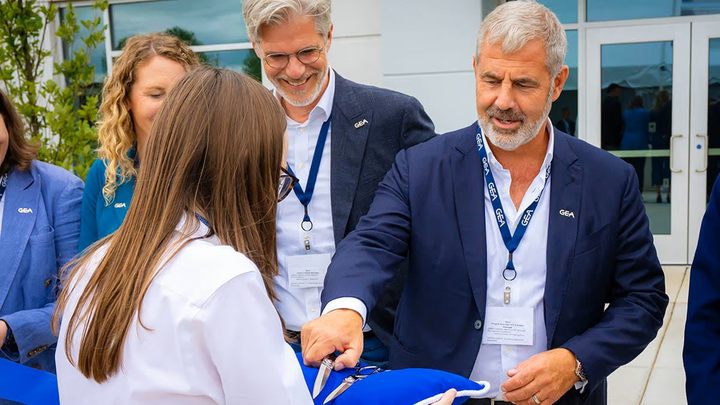
"The food industry is at a crossroads. To feed future generations sustainably, we must turn vision into scalable reality," says Stefan Klebert, CEO of GEA Group. "With this investment, we are helping our customers scale up the production of novel foods such as precision-fermented egg white and cultivated seafood." At the same time, GEA is strengthening its North American footprint, where 1,600 employees at 16 locations support manufacturing, sales, service, training and testing.
The ATC complements GEA's existing Janesville operations, where 74 employees work at the Separation & Flow Technologies facility. It creates new highly skilled positions, including engineering and scientific roles, and up to 500 contractors and subcontractors were involved in construction. Jimsi Kuborn, Economic Development Director for the City of Janesville, called the project "a model for what's possible" for the entire Midwest and beyond.
Jessica Almy, Interim CEO of The Good Food Institute in North America, said the center shows how innovation and agriculture can work hand in hand to create jobs, strengthen food security and address climate challenges. The facility opens as the U.S. leads the world in alternative protein investments.