“Rotaria was conceived as an open, collaborative space that helps people read and interpret the Roero,” says project spokesperson Nicola Pasquero-Hilberg. “It goes beyond wine, embracing the broader cultural identity of the region and translating its biodiversity into a clear, contemporary language. The name itself reflects the area’s history and our guiding principle: strengthening connections and enhancing a heritage of landscapes, traditions, and diversity.”
Built on three core pillars, the project aims to elevate the Roero’s geological and territorial richness, encourage knowledge-sharing among producers, and provide practical tools for communicating the region’s identity. “At the heart of Rotaria is the desire to give voice to a community of producers, restaurateurs, sommeliers, and wine lovers who want to become ambassadors for the Roero,” Pasquero adds.
The launch event in Pollenzo marked the beginning of Rotaria’s operational journey, featuring an initial analysis and comparative tasting session led by Master of Wine Wojciech Bońkowski. Insights from this meeting will guide the next development steps, supported by a suite of tools such as tasting notes, wine list suggestions, food-pairing ideas, and retail materials. These will be complemented by visual storytelling resources — images, videos, and artistic interpretations — designed to present the Roero in an engaging and accessible way.
At the core of Rotaria’s methodology is the integration of geological, sensory, and cultural dimensions. A simplified geological map of the Roero — based on the “Langhe e Roero geoviticultural” map and developed with Nicola Pasquero and Edmondo Bonelli — divides the region into three macro-areas: sand, marl, and clay. This straightforward structure serves as an intuitive tool for understanding how soil types, exposures, and landscapes shape the region’s identity.
Nebbiolo, the territory’s hallmark grape variety, becomes the project’s common thread, allowing producers to explore how soil composition, vineyard conditions, and viticultural choices influence its expression. Sandy soils deliver aromatic finesse and gentle tannins; marl brings depth and structure; clay lends power, intensity, and age-worthiness.
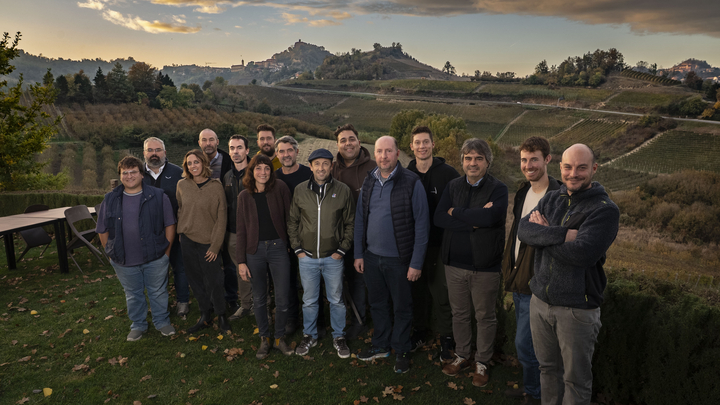
Rotaria’s collective includes producers of different sizes, histories, and stylistic approaches — including some based just outside the immediate area — all united by the ambition to contribute to a shared understanding of the Roero. Participation remains open to anyone who embraces the project’s collaborative, research-driven vision.